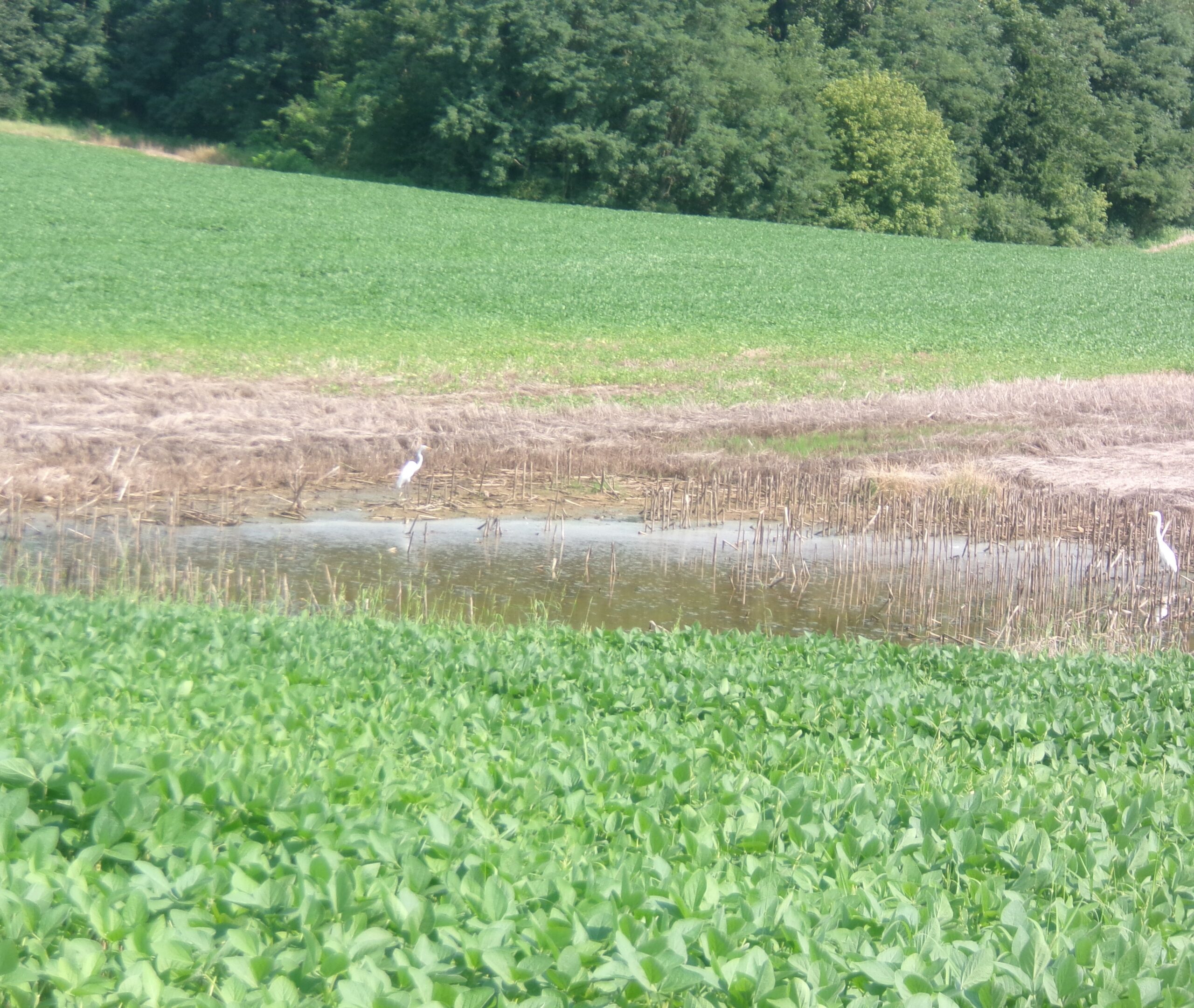
One does what one does until one finds a better way of doing–at least that’s the way it should be. But we live in a world where if better costs the current players money/profits, the better is suppressed and/or destroyed. Plowing…plowing is detrimental to the Earth, but plowing and fertilizer increase crop yields. No till is better for this Earth, but one sacrifices yield. Plus no till, if done correctly, decreases the need for fertilizer which is another profit center for corporations.
I read Octavia Butler’s Parable of the Sower (1993) and Parable of the Talents (1998). I’ll first talk about the titles.
Parable of the Sower found in Matthew 13:1–23, Mark 4:1–20, Luke 8:4–15
Sower is a homograph ( a word pronounced the same that has two meanings that are different.). “Sower” can mean a person or machine that scatters seed on the earth in order to grow flora or a person who introduces or seeks to foster a certain attitude, feeling, condition, etc., in others. For purposes of the title, both definitions are relevant.
Parable of the Talents Matthew 25:14-30
The word “Talents” is also a homograph. In ancient Rome a “talent” was a unit of currency and today’s meaning is a natural skill or aptitude. The latter meaning is the one meant by the title.
Octavia Butler introduces us to a United States where the social contract has been broken due to drugs; religion; illiteracy; classism; othering on the basis of physical and mental disabilities, sexual orientation, etc.; climate change; corporate greed; and lawlessness. (The author does not dwell on race as an “other” merely notes that it may cause problems in certain areas.) In “Sowers”, people live in walled, armed communities (if they’re lucky), or as the homeless do today in makeshift shelters or abandoned buildings, or as vagabonds. “Sowers” is a dystopian novel that follows the outline of all “seeker” stories, i.e., a restless person who is searching for their purpose or an object that will define them, a journey, accompanied by those they attract along the way, obstacles to overcome, the loss of companions either through death or a parting of the ways, and then what is sought is found. Sometimes, a life companion is also found during the journey. Joseph Campbell wrote about the Hero’s journey and many books follow his outline.
In “Sower”, the heroine is forcefully expelled from the relative safety of her home and forced to begin her journey. The object–her dream of a new religion that along the way she names “Earthseed”. Our heroine finds love and loss throughout her journey. She finds what she needs to implement her dream in Portland, Oregon.
I find that somewhat unbelievable, especially knowing Oregon’s history as it relates to Black people.
Wikipedia–The Oregon black exclusion laws were attempts to prevent black people from settling within the borders of the settlement and eventual U.S. state of Oregon. The first such law took effect in 1844, when the Provisional Government of Oregon voted to exclude black settlers from Oregon’s borders. The law authorized a punishment for any black settler remaining in the territory to be whipped with “not less than twenty nor more than thirty-nine stripes” for every six months they remained.[1] Additional laws aimed at African Americans entering Oregon were ratified in 1849 and 1857.[2] The last of these laws was repealed in 1926.[3] The laws, born of anti-slavery and anti-black beliefs,[2][4] were often justified as a reaction to fears of black people instigating Native American uprisings. Currently, I know some Black persons who live in Portland and recently talked to someone who had moved from Portland. He said that Oregon was a white supremacist territory outside of Portland. That is fact; Butler’ stories are fiction.
“Sower” and “Talents” are engaging, written well, and are much like other dystopian novels that I have read. As I have mentioned, I read many of Octavia Butler’s early books and, like these, found them readable and enjoyable, but something about them irked me and I stopped reading Butler’s books. In reading these two books, I’ve figured out why I stopped reading her books. There is a subliminal thread in Butler’s books that I read that essentially says that although I know that whites are violent, evil supremacists, if I just find that one good white person…everything will be alright. Being subliminal, the thread is not blatant. It’s almost like the Easter Egg in movies. There…and in a blink of an eye it is gone. Like, I think it was a Star Trek movie and an aficionado said that R2D2 was floating in the space debris. Since she watched the movie in an IMAX venue, R2D2 would have been more visible than on a regular screen because I looked and saw nothing, but I was watching on a small screen.
That is how the sequel abruptly ends–the heroine finds her “good” white person(s) in Portland and these white people are the enablers of her new religion. And, her traveling companions, I have not mentioned–a white male, a childhood friend; a Black woman who was bought to be a wife/sex and work slave by a Black man; some Hispanics; and a Black male physician are the main companions. The white male and the others are not of either the right class or ethnicity to be the enablers of the heroine’s religion.
I probably won’t reread these books. I have asked myself over and over again–why do we humans need this entity that we call “God”. The crux of her religion is that “change” is ever present (the only constant), so “God” is a metaphor for or is “Change”. Even though, the heroine says “God” is genderless, how can that be when the term she uses is gendered? “God” is the term for a male deity. An aside: she may as well have said that God is a metaphor for purpose–the grand purpose that is the destiny of the Earth beings.
I also take issue with the Black characters who were her companions on the road and in the building of the first community…she killed them all. It’s the old trope of who’s the first to die in the dystopian movie–usually a person of color. Is it so the heroine has control over her origin story. i.e., there is no one to contradict her. Or is she constructing a story like the Jesus story…born, parents flee to Egypt, a return in pre-teen years when danger over, questioning by the priests, then silence until he reappears at age thirty or so? I suppose a spokesperson for any god must be mysterious and there must be room to rearrange the origin story to suit the current issues plaguing the religion.
And, why if we Earth beings have failed this planet, why go elsewhere? Obviously, humans will not change if they have not learned from their past mistakes. Clean up the mess we’ve made of and on Earth, then maybe we humans will be “adult” enough to venture to other planets and meet what life there is in the cosmos.
Parallels to today: White Supremacist president who uses Christian Nationalism to entrench power; Christian Nationalists who believe the United States is a “Christian” nations when the most outspoken “fathers” were Deists; corporate greed and corporations failing to pay taxes; hedonistic entertainment; homelessness; illiteracy; devaluation of the female; classism; police patterned after the slave patrols and the Gestapo, the gutting of the 13th, 14th, and 15th amendments; the weakening of the Civil Rights laws of the 1960s; wanton destruction of Black creativity; and the general breakdown of the societal contract that enables people to live together in tolerance.
The books did not reference “toxic patriarchy” even though in the actions of the male characters it was on full display.
Just an observation–what kind of God says to its adherents bring believers to me by violence, murder, rape, brainwashing, torture, brutalization, terror, and I guarantee you a place by my side? That says to me that God is merely a puppet created by man to control those he can. Therefore, I, man, will be in control and use anyone I can to make my life on this earth, in this realm, one of sybaritic and hedonistic ease and God will be my shield.
—————————————————————
The first link in the chain was forged–the first speech censured; the first thought forbidden; the first freedom denied–chains us all irrevocably. The first time any man’s freedom is trodden on, we’re all damaged. Captain Picard Star Trek: The Next Generation
Make me want to holler
The way they do my life, yeah
Make me want to holler
The way they do my life, oh, yeah Excerpt from Inner City Blues by Marvin Gaye
Copyright 2026. All rights reserved.